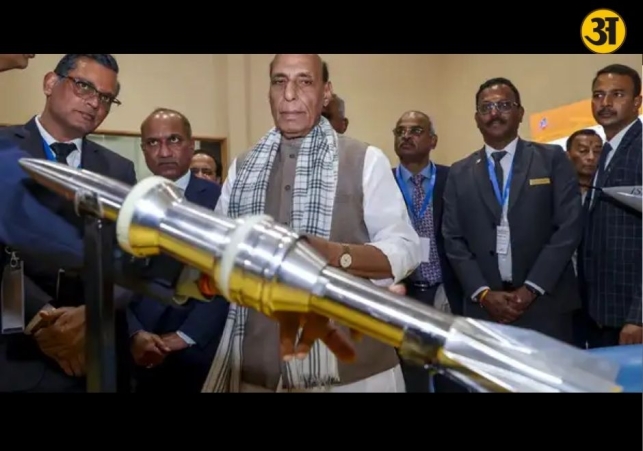
New BEL centre will assemble and test advanced missile systems
Rajnath Singh inaugurates missile integration facility to boost India’s defence strength
Defence Minister Rajnath Singh on Monday inaugurated a major missile integration facility at Bharat Electronics Limited (BEL) in Bengaluru. The new centre is expected to play an important role in strengthening India’s defence production and improving the country’s self-reliance in military technology.
During the ceremony, the Defence Minister also flagged off the Akash 3rd and 4th Regiment combat systems and introduced a new Mountain Fire Control Radar. He praised BEL for its steady progress in advanced defence technologies and said that the company has made strong contributions in areas such as electronic warfare, avionics, naval systems, electro-optics and tank electronics.
He said that BEL’s integrated systems and real-time data sharing capabilities have improved India’s network-centric warfare abilities. According to him, such developments are taking India’s combat readiness to a higher level and reducing dependence on foreign suppliers.
The new missile integration facility is seen as a major step towards building and deploying advanced missile systems more efficiently within the country.
What is a missile integration facility?
A missile integration facility is a highly secure and specialised centre where different parts of a missile are brought together, assembled and tested before being declared ready for use. Modern missiles are complex systems made up of many subsystems. These include propulsion systems, guidance and navigation units, control electronics, communication modules and, in military missiles, the warhead section.
Each of these components may be developed and manufactured separately. The integration facility is where engineers combine all these parts into one complete and functional missile system.
Integration does not simply mean attaching parts together. It also involves making sure that the hardware and software systems work smoothly with each other. Engineers conduct several checks to ensure that electrical connections are stable, software codes are properly installed, and sensors are functioning correctly.
The facility also carries out environmental testing. Missiles must be able to operate in extreme conditions such as high temperatures, humidity, vibrations and shock. Therefore, they are tested under simulated conditions to ensure reliability and safety.
Simulated launch procedures are also performed. These tests help confirm that the missile will respond correctly to launch commands and operate as expected once fired. Only after passing multiple layers of testing is a missile cleared for operational deployment.
In simple words, a missile integration facility is the final assembly and quality-check centre that prepares a missile for real-world use.
How missile integration works
Missile integration also includes connecting the missile to the platform from which it will be launched. A missile may be launched from a fighter aircraft, a naval ship, a submarine or a ground-based launcher. Each platform has its own technical requirements.
The integration process begins with mechanical mounting. The missile must be securely attached to the launch platform. This ensures that it remains stable during movement, take-off or sailing.
Next comes electrical and data integration. The missile must receive power from the platform and be able to communicate with it. For example, a fighter jet’s radar system must send targeting information to the missile before launch. The aircraft’s onboard computer must recognise the missile type and be able to control it until the moment of release.
Software compatibility is another key step. Engineers ensure that the missile’s software can communicate properly with the aircraft or launcher system. If there is any mismatch, it could affect targeting accuracy or even safety.
After installation, extensive testing is carried out. This includes ground simulations, taxi trials for aircraft, and sometimes live firing tests. These steps confirm that the missile launches safely, separates properly from the platform and follows the intended flight path.
The new facility at BEL is designed to streamline this entire process under one roof. It will allow faster and more efficient integration of advanced missiles with various aircraft of the Indian Armed Forces.
For example, the Sukhoi Su-30MKI can carry missiles such as Astra and BrahMos. The Dassault Rafale is integrated with missiles like Meteor and SCALP. With the new facility, testing and integration of such advanced systems can be done more efficiently in India.
This development also supports the work of organisations like the Defence Research and Development Organisation (DRDO), which designs and develops many of India’s missile systems.
By building such infrastructure domestically, India moves closer to its goal of “Atmanirbhar Bharat” in defence. It reduces the need to depend on foreign facilities for integration and testing. It also speeds up the deployment process during emergencies.
The inauguration of this missile integration facility marks an important milestone for India’s defence industry. It strengthens coordination between research agencies, public sector units and the armed forces.
As regional security challenges continue to evolve, advanced and reliable missile systems are becoming more important. With this new centre in Bengaluru, India has added a critical capability that will support its armed forces and enhance national security in the years ahead.
Related News


.jpg)